
We have all heard that sickening crunch from inside the CNC enclosure. The machine hesitates, the spindle load spikes past 180%, and before your hand can even reach for the feed hold, an expensive drill has snapped off five inches deep inside a pre-machined 4140 manifold block.
When you fish out the broken stump, the diagnosis is usually obvious: the chisel edge is blue, the margins are burned to a cinder, and the flutes are jammed solid with packed chips.
A lot of operators will blame the carbide grade, blame the coating, or immediately dial back their feeds and speeds. But in nine out of ten deep-hole failures, the cutting tool was doomed the second the cycle started. Trying to flush an 8xD blind hole with standard external flood coolant is practically the same as spitting on a campfire.
If you are fighting premature tool wear, flank annealing, and flute jamming in deep holes, switching to an internal delivery system is not just an optional upgrade; it is an absolute necessity. In this guide, we will break down the mechanics of through coolant vs flood cooling, explore why thermal vapor locks destroy cutting edges, and look at how a properly specced coolant through carbide drill transforms deep hole reliability.
To understand why flood coolant falls short, look at what happens inside the hole once your tool goes beyond three times its diameter (3xD).
The Deep Hole Fluid Barrier:
When drilling past 3xD, the narrow space between the drill flutes and the hole wall turns into a turbulent counter-flow chimney. External coolant tries to force its way downward while boiling chips and steam fight violently to rush upward. The chips almost always win.
In standard flood setups, cutting fluid nozzles spray the outside of the tool holder and the workpiece surface. At hole depths up to 2xD or 3xD, gravity and tool rotation pull just enough fluid down the flutes to lubricate the margins. But once you plunge deeper, two immediate physical barriers occur:
At the shear zone where the cutting edge shears metal, localized temperatures quickly surpass 800°C (1472°F). When external fluid finally trickles down into that zone, it does not wet the cutting face. Instead, it instantly vaporizes, creating a pressurized steam cushion.
This thermal blanket—an example of the Leidenfrost phenomenon documented across high-temperature fluid mechanics—physically insulates the cutting edge from the liquid coolant. The drill tip runs completely dry despite coolant washing over the part surface. Without the continuous internal delivery of a coolant through carbide drill, the tool edge overheats rapidly.
Coolant is not just there to keep things cool; it is primarily a conveyor belt for chips. As chips shear off, they must curl into tight spirals and glide up the flutes. Without fluid pressure behind them pushing from the tip upward, the chips stall out.
The spinning tool rubs against stalled swarf, work-hardening the parent material, re-cutting chips, and wedging metal against the hole wall until the drill wedges and snaps. A purpose-built coolant through carbide drill forces chips upward from behind, clearing the flute channel instantly.
When calculating feeds and speeds for deep hole machining, cutting speed (Vc) and metal removal rate (MRR) dictate the heat generated:
In deep hole applications, keeping your fn consistent is critical. If you back off your feed because you are afraid of breaking the drill, the cutting edge will merely rub instead of shearing, building up intense friction. Yet, you cannot maintain that crucial chip load with flood cooling because the heat has nowhere to go. This is precisely where a high-performance coolant through carbide drill changes the equation.
When people compare through coolant vs flood setups, they often look only at the pump purchase price or the machine option cost. That is short-sighted. Look at how both methods perform in day-to-day production environments:
| Parameter / Feature | External Flood Cooling | Coolant Through Carbide Drill |
|---|---|---|
| Coolant Pressure at Cut Zone | Near 0 bar (dispersed spray) | 20 bar to 70+ bar (300 to 1000+ PSI) |
| Cutting Zone Temperature | 700°C – 950°C (uncontrolled spikes) | Maintained at 150°C – 250°C |
| Max Safe L/D (Without Pecking) | 3xD to 5xD maximum | 8xD, 12xD, 20xD, up to 30xD continuous |
| Chip Evacuation Dynamic | Chips drag along flutes; re-cutting | Chips hydrodynamically forced out |
| Cycle Times | Slow (requires multi-stage pecks) | Fast (single continuous plunge) |
| Flank and Margin Tool Wear | Severe micro-chipping, tip annealing | Uniform, predictable abrasive wear |
| Typical Tool Life (Parts/Drill) | Baseline (1.0x) | 3.0x to 5.0x baseline lifespan |
| Hole Straightness & Finish | Prone to drift, Ra 3.2 – 6.3 µm | Rigid tracking, Ra 0.8 – 1.6 µm |
With an internal coolant carbide drill series, fluid travels through twisted internal helical passages directly out the drill face. The fluid exits right at the cutting lips and chisel edge, creating an immediate hydraulic jet that breaks up the vapor barrier. Using a coolant through carbide drill guarantees that fluid reaches the cut zone regardless of hole depth.
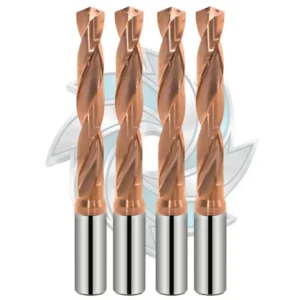


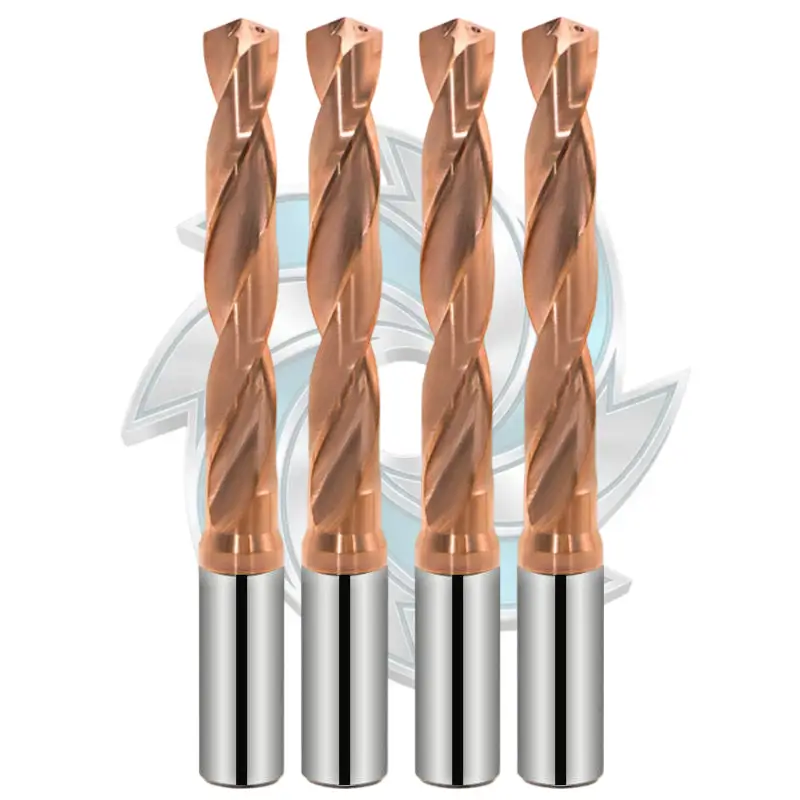

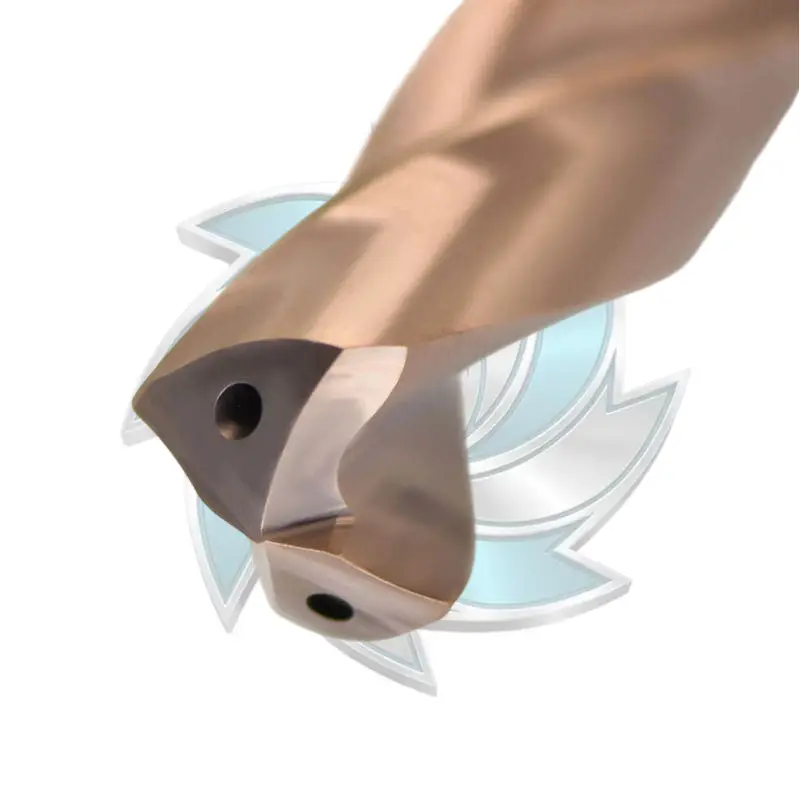
The internal coolant carbide drill delivers superior penetration rates and high-feed reliability in deep-hole CNC operations. Equipped with dual internal fluid channels, this internal coolant carbide drill rapidly dissipates cutting heat while flushing chips efficiently. Durable Mills manufactures high-precision internal coolant carbide drills tailored for stainless steel and cast iron machining.
If you inspect dull tooling under an optical comparator or shop microscope, the drill tells its own story. Cutting tool wear patterns adhere to classic engineering frameworks defined by standard models like ISO cutting tool standards and documented on Wikipedia’s tool wear reference.
In deep hole drilling, tools generally suffer from three catastrophic wear conditions when starved of fluid:
“If the drill margins look like melted candle wax and the chisel point is missing its coating, you did not have a feeds and speeds problem—you starved the cutting edge of fluid pressure.”
Solid carbide is tough, but it relies on a cobalt binder to hold the tungsten carbide (WC) grains together. When the drill point dwells in an uncooled cut zone past 800°C, cobalt leaching and plastic deformation take place.
The cutting edge softens (anneals), loses its micro-hardness, and dulls rapidly. Once the tip dulls, cutting forces skyrocket. A coolant through carbide drill injects continuous fluid directly against the chisel edge, keeping temperatures well below the binder’s critical thermal threshold. By keeping the cobalt matrix rigid, the coolant through carbide drill prevents premature edge collapse.
When machining gummy materials like 304/316 stainless steels, duplex alloys, or structural aluminum, heat causes the chip to stick to the rake face. Layers of work-hardened material build up, tear away, and take microscopic chunks of carbide with them.
Because a coolant through carbide drill keeps the interface lubricated and cold, the chip slides across the polished rake without friction welding, eliminating the destructive cycle of BUE and edge pull-out. Machining gummy metals without a coolant through carbide drill almost always leads to torn hole surfaces and torn cutting edges.
When operators run flood coolant, they are forced to peck to clear chips. But every time that drill retracts from the hole and gets drenched by an external nozzle, it undergoes severe thermal shock. The carbide expands in the cut, rapidly contracts when hit by the external spray, and forms micro-cracks along the cutting edge.
Within dozens of holes, those comb cracks turn into jagged edge chipping. By switching to a coolant through carbide drill, you run one solid, uninterrupted feed stroke, eliminating thermal cycling entirely. A coolant through carbide drill keeps the temperature constant from the top of the hole to the bottom.
Machinists who cut their teeth on high-speed steel (HSS) twist drills were taught a golden rule: peck, clear the chips, peck deeper. That approach makes sense for flexible HSS tools that cannot tolerate heat and require regular chip clearance.
With modern solid carbide deep hole drilling tools, continuous pecking is one of the worst things you can do to your bottom line.
Here is why:
According to deep-hole drilling technical data published by tooling pioneers like Sandvik Coromant’s drilling knowledge base, running a modern coolant through carbide drill allows you to drill 5xD, 8xD, or even 12xD in a single continuous pass without a single peck cycle. The continuous fluid stream flushes chips faster than the drill can cut them. When shops switch from pecking with standard tools to a continuous plunge with a coolant through carbide drill, tool life jumps instantly.
Let us look at a real-world machining floor scenario. An industrial valve manufacturer was running a contract involving 4140 pre-hardened steel blocks (30–34 HRC). The job required drilling eight blind lubrication ports per manifold, each measuring 8.5 mm (0.334 in) in diameter and 68 mm deep (an 8xD hole depth ratio).
The shop replaced the standard drill with an 8.5 mm coolant through carbide drill from Durable Mills running on their machine’s 50 bar (725 PSI) through-spindle coolant system.
| Metric | Old Setup (Flood Coolant) | Upgraded Setup (Coolant Through Carbide Drill) | Operational Gain |
|---|---|---|---|
| Cycle Time Per Hole | 48 seconds (peck cycle) | 7.5 seconds (single pass) | 84% reduction |
| Tool Life (Holes per Drill) | 42 holes (unstable) | 218 holes (consistent) | 419% increase |
| Part Surface Finish | Ra 3.8 µm | Ra 1.1 µm | Mirror-like walls |
| Operator Intervention | Cleared chip nests every 3 parts | Completely unattended run | Lights-out capable |
By trusting a dedicated coolant through carbide drill, the shop eliminated an entire shift bottleneck and paid off the new tooling within the first week of production. The consistent evacuation provided by the coolant through carbide drill meant zero scrap parts from broken drills stuck in expensive blocks.
Buying a premium coolant through carbide drill is only half the battle. If your CNC machine’s through-spindle coolant (TSC) system is not properly maintained, you will not get the performance the drill was engineered to deliver.
There is a common misconception that pressure is the only metric that matters. Pressure breaks the vapor barrier, but flow rate carries the heat and chips away.
For small drills under 3.0 mm, internal coolant passages are microscopic, meaning you need extreme pressure (often 70 bar / 1000 PSI or higher) just to overcome wall friction inside the drill’s channels.
For drills over 12 mm, internal holes are larger, requiring higher volume (gallons or liters per minute) to keep the flutes packed with fluid. A larger coolant through carbide drill demands high volume so that swarf never encounters an empty pocket in the flute.
For deeper insight into the relationship between fluid dynamics and tool interface temperatures, review technical research like engineering reference on cutting fluid dynamics. Matching your pump pressure to your specific coolant through carbide drill ensures consistent chip evacuation.
A single tiny metal chip or swarf particle circulating through your coolant tank can lodge inside an internal coolant orifice. When one hole clogs on a coolant through carbide drill, hydraulic pressure becomes asymmetrical.
The cutting edge on the clogged side overheats instantly, leading to rapid drill fracture. Always run bag filters or paper band filters down to 10 microns (or 5 microns if you are running micro-drills) to protect your coolant through carbide drill investment. Without clean filtration, even the finest coolant through carbide drill will suffer premature failure.
Do not run lean coolant to save a few dollars on concentrate. For general turning or light milling, a 5% to 6% water-soluble oil concentration might suffice. But deep hole operations demand high lubricity to reduce flute friction.
Keep your refractometer readings between 8% and 12% when running deep hole jobs with a coolant through carbide drill. The extra lubricity prevents chips from sticking to the flute surfaces during evacuation, allowing your coolant through carbide drill to run cooler and last longer.


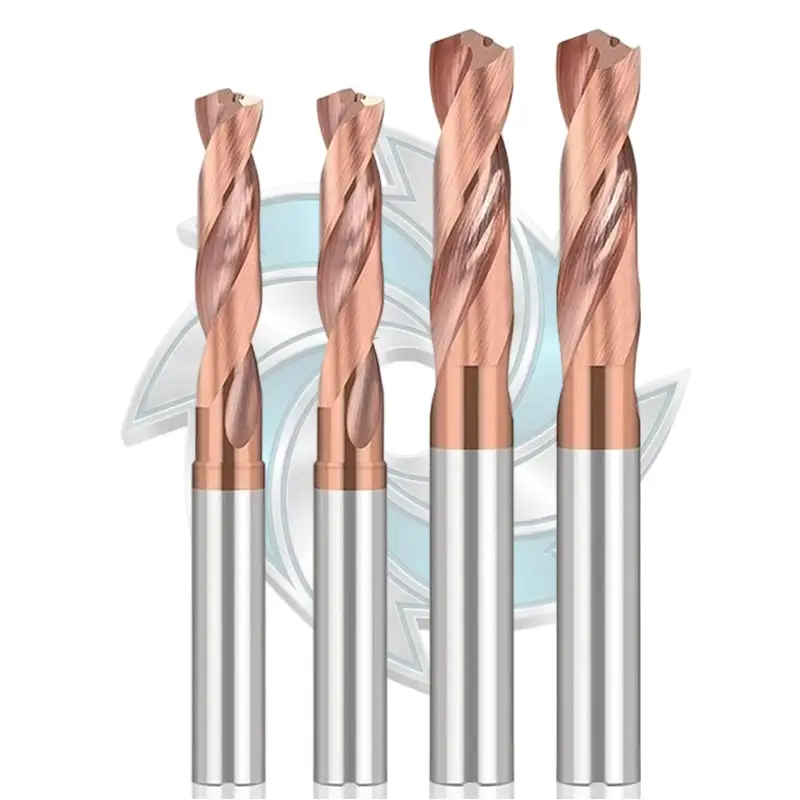
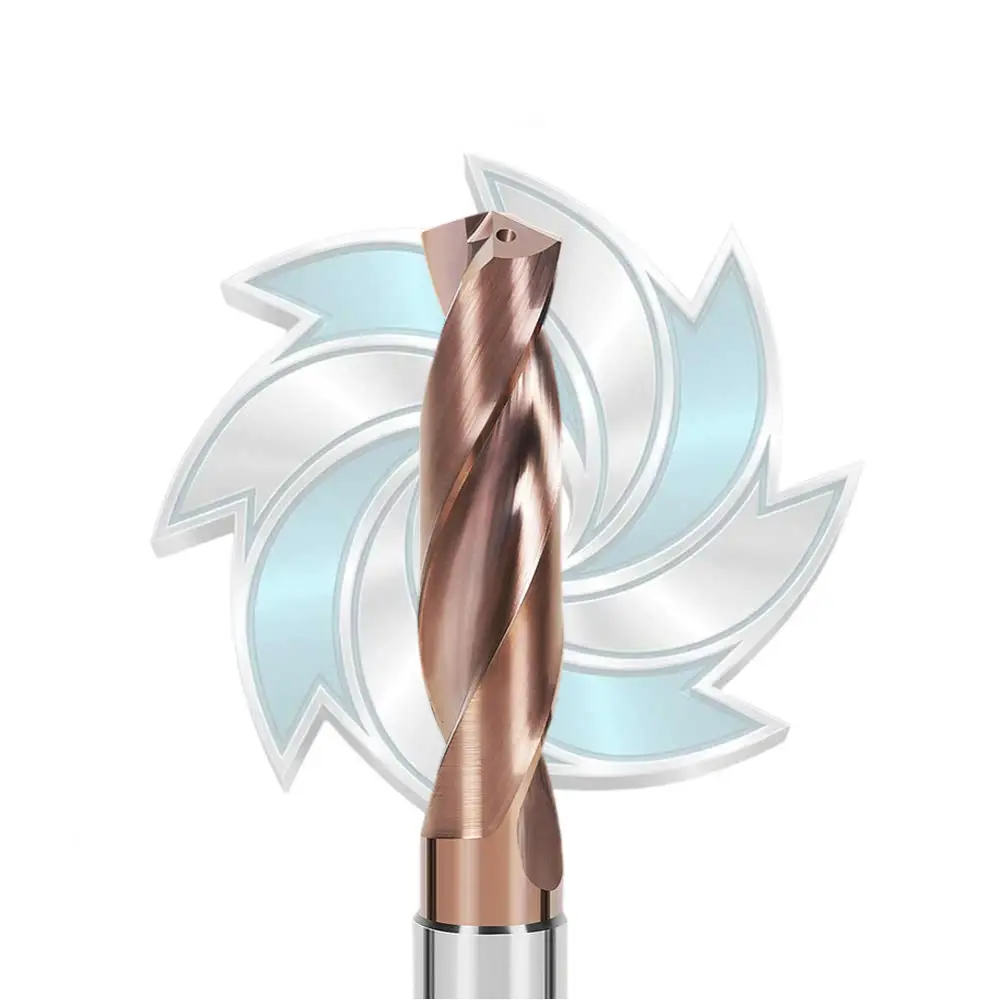
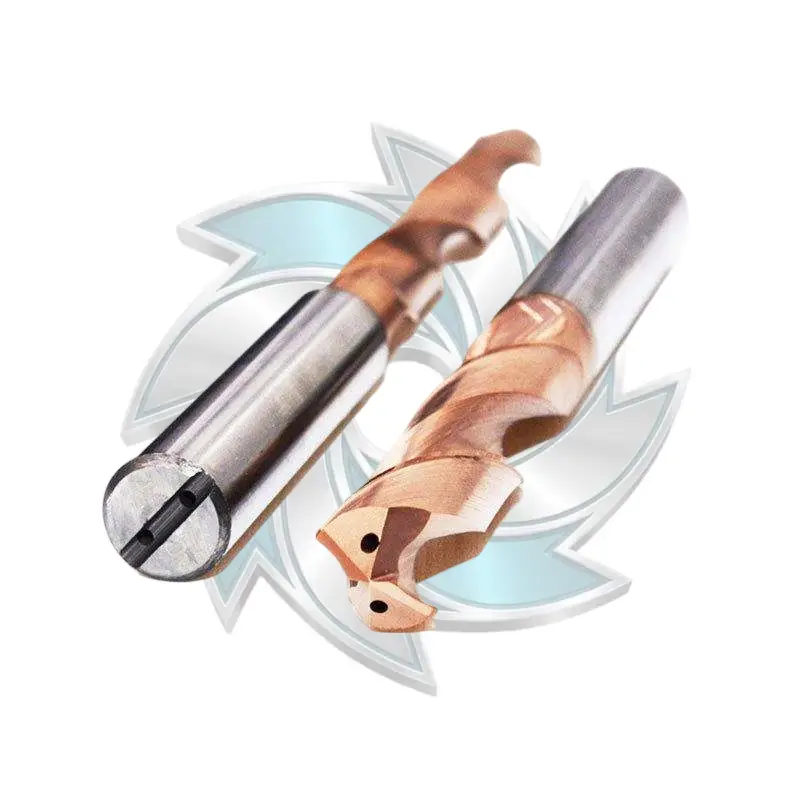
Engineered for precision metalworking, this high-performance coolant through carbide drill delivers superior heat dissipation and chip evacuation in deep-hole operations. Manufactured by Durable Mills, our solid carbide drills ensure exceptional surface finishes across stainless steel, alloy steel, and cast iron. Upgrade your CNC production line with reliable coolant-fed carbide drill tooling built for long service life.
Not all carbide drills are built the same. When sourcing deep hole tooling, picking the right carbide twist drill supplier is crucial to maintaining consistent cycle times across production batches. Working with an experienced carbide twist drill supplier ensures your tools have the precise substrate toughness needed for difficult alloys.
“Sub-micron grain substrates provide the boundary line between an edge that micro-chips under heavy chip loads and one that wears evenly across thousands of inches of metal.”
When evaluating a carbide twist drill supplier, look for these manufacturing fundamentals:
Explore our full range in the internal coolant carbide drill catalog to find tools purpose-built for stainless, titanium, cast iron, and hardened tool steels. When your carbide twist drill supplier understands high-pressure fluid mechanics, your machining processes become much more predictable.
If you are setting up your first 8xD or deeper job with an internal-feed tool, follow this proven programming sequence to prevent immediate tip fracture:
Following this regimented workflow ensures your coolant through carbide drill operates in clean, lubricated conditions from entry to breakout. Treating your coolant through carbide drill with proper pilot procedures drastically extends tool life.
Technically, yes, but it is a massive waste of tooling potential. If you run a coolant through carbide drill with external flood cooling, the internal coolant holes sit empty.
External fluid will not enter those holes against centrifugal force; in fact, the empty internal channels can slightly reduce tool rigidity compared to a solid drill. If your machine lacks through-spindle coolant capabilities, stick with a solid drill and accept the need for shorter depths or careful pecking rather than buying an advanced coolant through carbide drill.
For holes between 5xD and 8xD using a coolant through carbide drill with a diameter greater than 6 mm, a minimum pressure of 20 bar (300 PSI) is usually sufficient.
However, if you are running micro-drilling applications (under 3 mm) or drilling deep holes up to 12xD–20xD, you will need 50 to 70+ bar (725 to 1000+ PSI) to ensure fluid overcomes centrifugal friction and forces chips up the flutes of your coolant through carbide drill.
Chip packing with a coolant through carbide drill usually traces back to one of three issues:
1. Low feed rate: If your feed rate (fn) is too light, the coolant through carbide drill creates thin, stringy shavings instead of tight, segmented “C-shaped” chips. Those long ribbons jam flutes easily.
2. Low coolant concentration: Increase your emulsion concentration to 10–12% to boost lubricity around the coolant through carbide drill.
3. Low coolant pressure or volume: If the pump cannot maintain rated pressure under full flow, chips lose their hydraulic velocity and stall out inside the hole around the coolant through carbide drill.
Pecking is rarely necessary with a coolant through carbide drill up to 8xD or 12xD in standard steels and irons. However, in extremely long L/D ratios (such as 20xD or 30xD) or when cutting challenging materials like Inconel 718 or pure copper, a specialized “micro-peck” cycle (retracting only 0.5 mm to break the chip without exiting the hole) can help prevent chip binding without shocking the coolant through carbide drill.
Let’s be blunt: watching expensive carbide drills snap off inside half-machined components is an expensive way to learn that flood cooling has limits. Every hour your operators spend pecking deep holes, picking out chip nests, or digging out broken tool points with an EDM disintegrator is wasted profit.
At Durable Mills, we engineer high-performance deep hole drilling tools built to handle heavy feeds, intense thermal loads, and aggressive production environments. As an established carbide twist drill supplier, we provide tooling that cuts straighter, runs faster, and lasts significantly longer. Every coolant through carbide drill we produce undergoes rigorous inspection to ensure hole concentricity and mirror-smooth flute finishes.
Stop cooking drill tips and fighting chip jams. Switch to an engineered coolant through carbide drill from Durable Mills, and watch your cycle times drop and your tool life climb.


