
Walk out onto almost any machine shop floor at 2:00 PM on a Tuesday, and you’ll spot the exact same argument playing out between a setup guy and a programmer. There is a block of pre-hardened 4140 alloy steel clamped in a Kurt vise, and someone is about to rough out a deep cavity. The operator wants to grab a 2-flute tool because they’re terrified of packing chips and snapping an expensive cutter inside an eighty-pound blank. Meanwhile, the programmer is shouting over the spindle squeal that a 2-flute will take forever, vibrate itself to death, and leave a surface finish that looks like corrugated roofing.
Who wins that argument? Most of the time, the programmer is right—assuming they know how to actually deploy a 4 flute solid carbide end mill. But if you just drop a 4-flute into a deep slot without adjusting your radial width of cut or your chip clearance strategy, that operator will get to say “I told you so” within thirty seconds of spindle engagement.
Selecting between a 2-flute cutter and a 4-flute cutter isn’t a matter of personal taste or shop superstition. It boils down to solid mechanics: core diameter, deflection resistance, chip valley volume, and thermal transfer through the tool substrate. If your shop cuts carbon steels, chrome-moly alloys, mold steels like P20, or fully hardened D2, picking the right solid carbide milling cutter is often the single fastest way to trim fifteen to thirty percent off your cycle times while keeping scrap rates near zero.
Why Flute Count Changes Everything: Rigidity vs. Chip Valley Volume
Before diving into steel-specific feeds and speeds, look closely at the cross-section of both tools under an optical comparator. The fundamental tradeoff of cutting tool design is brutally simple: you cannot have massive chip pockets and extreme core rigidity at the exact same time.
A two-flute tool gives up its core web thickness in order to open up two massive helical troughs. On a standard 1/2-inch (12.7 mm) two-flute cutter, the central core web typically makes up only 30% to 40% of the outer cutter diameter. That leaves cavernous flutes that can effortlessly swallow long, stringy chips from gummy materials like 6061-T6 aluminum or low-carbon 1018 cold-rolled steel.
In contrast, an industrial 4 flute solid carbide end mill beefs up the central core web to roughly 55% to 65% of the tool diameter. That extra tungsten carbide in the center doesn’t look like much to the naked eye, but its impact on mechanical stiffness is massive.
The Deflection Formula Every Machinist Feels
Tool deflection during a side-milling or profiling cut directly follows classic cantilever beam mechanics. The linear deflection at the cutting tip follows this plain-text formula:
Deflection (delta) = (F * L^3) / (3 * E * I)
Where:
- delta: Total tool tip deflection (mm or inches)
- F: Radial cutting force acting perpendicular to the tool axis (Newtons or lbf)
- L: Tool overhang / stickout from the collet or shrink-fit chuck face (mm or inches)
- E: Young’s Modulus of the tool substrate (around 580 to 650 GPa for sub-micron tungsten carbide)
- I: Area moment of inertia of the tool’s cross section
That area moment of inertia (I) for a simplified solid round beam is:
I = (pi * d^4) / 64
Notice that the core web diameter (d) is raised to the fourth power.
If a 4 flute solid carbide end mill has a core diameter of 0.60 * D, while a 2-flute tool has a core diameter of 0.38 * D, let’s look at the relative stiffness:
(0.60)^4 = 0.1296
(0.38)^4 = 0.0208
0.1296 / 0.0208 = 6.23
Even after accounting for the relief gashes, a 4 flute solid carbide end mill provides roughly four to six times the deflection resistance of a standard 2-flute tool of the same diameter and stickout.
When you push a cutter into 30 HRC or 50 HRC steel, high radial forces push the tool sideways. If the tool deflects even 0.03 mm (just over a thousandth of an inch), two catastrophic things happen:
- The real chip thickness deviates wildly from your programmed feed per tooth, causing the flutes to rub rather than shear. Rubbing generates extreme localized heat and work-hardens the steel surface instantly.
- Deflection breeds regenerative chatter. Once harmonic vibration starts inside a steel cut, the brittle cutting edges on your 4 flutes carbide milling bit will micro-fracture along the primary relief within minutes.
By choosing a rigid 4 flute solid carbide end mill, you hold your programmed chip thickness steady, keep harmonics under control, and maintain straight, perpendicular wall profiles without having to take three spring passes.
2 Flute vs 4 Flute End Mill for Steel: Direct Head-to-Head
Machinists often ask: When can I get away with 2 flutes, and when is a 4-flute non-negotiable? To break it down without academic jargon, here is how both geometries behave when chewing through carbon and hardened steels.
| Machining Parameter | 2-Flute Carbide End Mill | 4 Flute Solid Carbide End Mill |
|---|---|---|
| Typical Core Web Thickness | 35% – 42% of cutter diameter | 55% – 65% of cutter diameter |
| Deflection Resistance (Stiffness) | Low; prone to bending on long stickouts | Exceptionally high (up to 5x stiffer) |
| Max Feed Rate at Equivalent Chipload | Baseline (1x table feed) | Doubled (2x table feed) |
| Full Slotting (1.0 x D width) | Excellent chip evacuation; low packing risk | Requires careful depth steps or peck slotting |
| Trochoidal / Dynamic Milling | Inefficient; limits table feed speeds | Industry standard; excels at high feed profiling |
| Finish Pass Surface Roughness (Ra) | Higher scallop height; rougher side walls | Glass-like finishes at practical feed rates |
| Heat Dissipation into Tool Body | Lower mass; thermal saturation happens quickly | Higher carbide mass pulls heat away from cutting edge |
| Best Suited Steel Hardness Range | Annealed structural steels, gummy low-carbon (< 24 HRC) | Medium-carbon, alloy steels, tool steels (28 to 55+ HRC) |
For deep-slot plunging where chips cannot escape laterally, a HRC55 Steel 2 Flute Flat End Milling Cutter still has a place, even in steel. But for modern toolpaths that favor high radial engagement shoulders or high-speed dynamic trochoidal loops, a 4 flute solid carbide end mill leaves two-flute tools far behind.
Feed Rates, Surface Finishes, and the Math Behind Production Speeds
Why do high-volume production managers insist on four flutes? Because machine time costs anywhere from $85 to $220 an hour depending on whether you’re running a vertical machining center or a 5-axis cell.
Table feed rate in CNC milling is calculated using this formula:
Vf = fz * z * n
Where:
- Vf: Table feed velocity (mm/min or inches/min)
- fz: Desired feed per tooth / chip load (mm/tooth or inches/tooth)
- z: Number of active cutting flutes
- n: Spindle speed (RPM), calculated as: n = (Vc * 1000) / (pi * D)
Notice the multiplier z. If you’re cutting 4140 annealed alloy steel with a 10 mm diameter cutter at a surface speed (Vc) of 120 m/min, your spindle speed is roughly 3,820 RPM.
If the recommended safe chip load (fz) for this tool is 0.04 mm per tooth:
- With a 2-flute end mill: Vf = 0.04 * 2 * 3,820 = 305 mm/min
- With a 4 flute solid carbide end mill: Vf = 0.04 * 4 * 3,820 = 610 mm/min
You have doubled your linear material removal rate without increasing spindle RPM, without driving up surface speed, and without increasing thermal stress on the carbide edge. For any contract shop billing parts on tight margins, doubling your table feed on roughing and semi-finishing runs changes everything.
How Flute Count Shapes Surface Finish
Understanding Scallop and Cusp Geometry on Finished Walls:
- On a 2-flute tool operating at a given table feed rate, the distance between successive tooth impacts is relatively wide. This creates wider, deeper scallop cusps on the finished wall, leading to a visibly rougher texture and a higher Ra reading.
- On a 4 flute solid carbide end mill cutting at that same feed rate, the distance between tool marks is sliced exactly in half. The peak-to-valley cusp height drops dramatically, producing a uniform, reflective finish straight off the machine.
Because the advance per tooth on a 4 flute solid carbide end mill is half that of a two-flute tool at identical machine feed rates, cusp height between passes is dramatically reduced.
According to machining reference standards maintained by the Machining Cloud repository and standard cutting tool geometry manuals published via the International Organization for Standardization (ISO 13399 for cutting tools), high-rigidity tools with four or more flutes are mandatory whenever target surface finishes drop below Ra 0.8 micrometers (32 micro-inches) in structural and hardened steels.
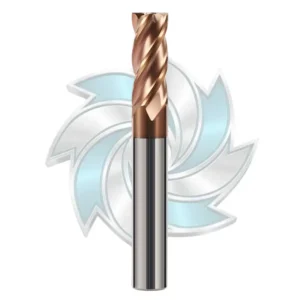
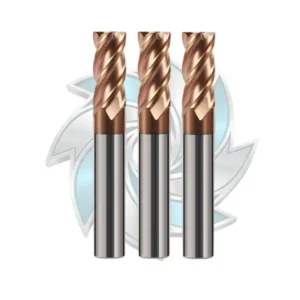
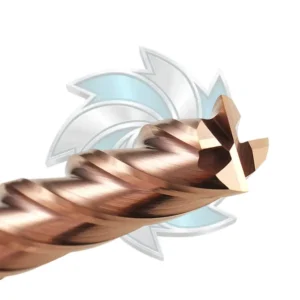
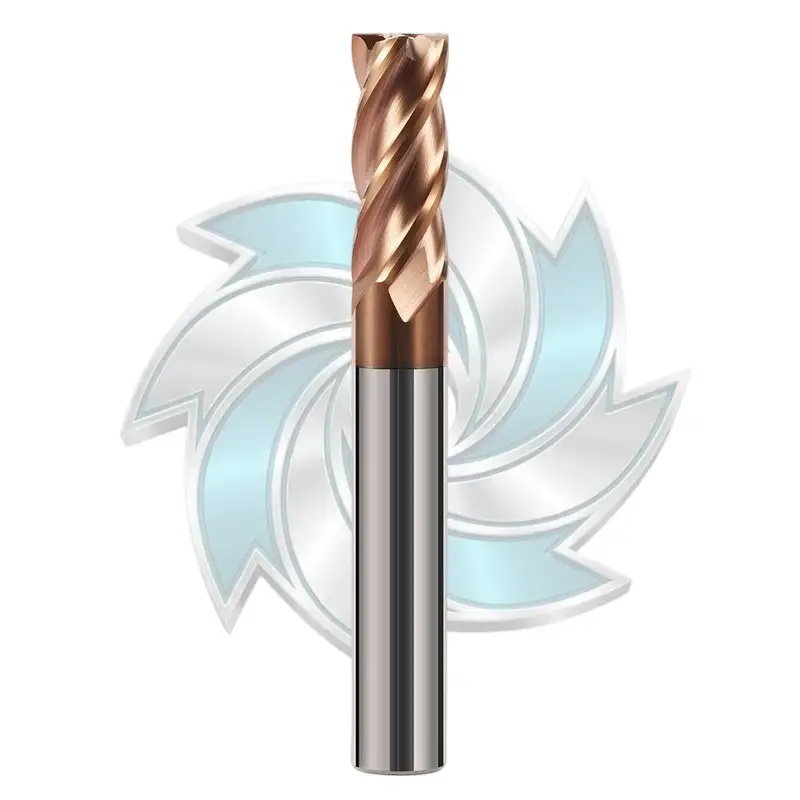
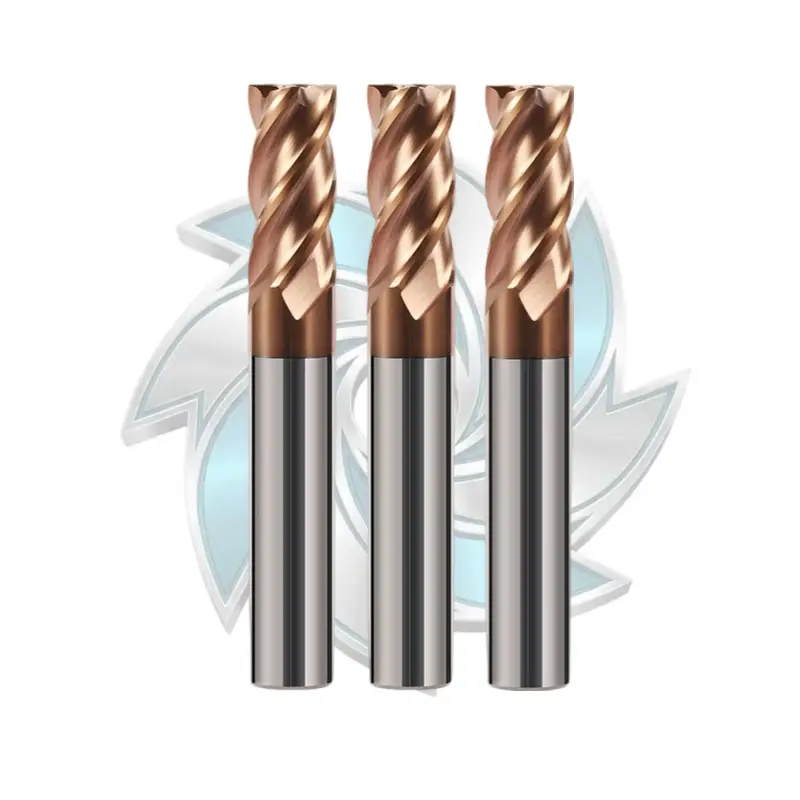
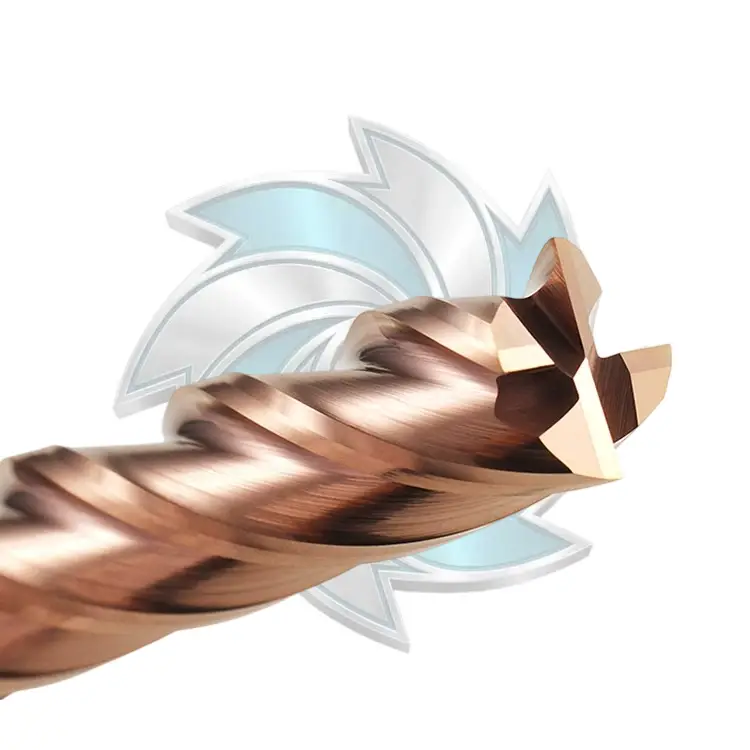
HRC55 4 Flute Solid Carbide Flat End Mill
The HRC55 4 flute solid carbide end mill is engineered for high-precision side milling, slotting, and profiling on carbon steel, alloy steel, and cast iron. Crafted with premium solid carbide, this HRC55 4 flute solid carbide end mill features an optimized negative rake angle to prevent edge chipping during heavy CNC machining. Sourcing our 4-flute carbide end mills for HRC55 steel ensures superior wear resistance, reduced tool change downtime, and consistent dimensional accuracy for B2B industrial manufacturing.
When to Use 4 Flute Carbide End Mill Geometries
A common misconception among newer operators is that a 4 flute solid carbide end mill is strictly a finishing tool. That might have been true back when people ran heavy conventional side milling on sloppy manual Bridgeport mills, but modern CNC controls and CAM software have completely rewritten the rules.
1. High-Efficiency Milling (HEM) and Dynamic Trochoidal Toolpaths
In modern CAM strategies (like Mastercam Dynamic Motion, Fusion 360 Adaptive Clearing, or Siemens NX VoluMill), you run a low radial depth of cut (ae = 5% to 15% of cutter diameter) paired with a deep axial depth of cut (ap = 1.5x to 3x cutter diameter).
Because the radial engagement is small, radial chip thinning occurs. You can calculate your actual average chip thickness (hm) using this plain-text formula:
hm = fz * sqrt(ae / D)
Because hm is much smaller than programmed fz, you must aggressively accelerate table feeds to avoid tool rubbing. A 4 flute solid carbide end mill is the absolute sweet spot here. Its rigid core shrugs off high-speed centrifugal vibration, while its four cutting edges cycle through the low-engagement arc rapidly, ejecting tiny, comma-shaped chips long before they can weld to the rake face.
2. Squaring Shoulders and Wall Finishing
When holding tight dimensional tolerances on deep vertical walls, tool push-off is your enemy. A 2-flute cutter will flex outward under load, creating a tapered wall that is wider at the floor than at the top.
A dedicated square flat end mill with four flutes resists that lateral push-off. The secondary flute supports the cut while the primary flute shears the material, neutralizing vibration and delivering vertical walls true to within tenths of a thousandth.
3. Machining Hardened Tool Steels (45 to 55+ HRC)
Once steel is quenched and tempered into the 45–55 HRC range (such as D2, A2, H13, or Hardox wear plate), shearing chips takes immense unit pressure. Trying to plow through hardened tool steel with an open 2-flute cutter causes edge micro-chipping.
A premium solid carbide square end mill for hardened steel engineered with four flutes features a reinforced negative or neutral rake angle. This geometry puts the cutting edge in compressive stress rather than shear stress, preventing the razor-thin carbide edge from crumbling under high mechanical pressure.
Real-World Case Study: Milling P20 Mold Cavities (HRC 38)
To see the real-world difference, consider this recent production scenario from a Midwest tooling shop cutting ejector-pin pockets and deep cavities in pre-hardened P20 mold steel (38 HRC).
The shop had historically stuck with a 3/8″ (9.525 mm) 2-flute cutter because machinists worried that deep pocket corners would bind up with chips. Their baseline cycle time per mold half was 84 minutes, and tool life topped out at two parts per end mill before severe flank wear ruined surface finishes.
| Machining Metric | Baseline Setup (2 Flutes) | Optimized Setup (Durable Mills 4 Flute) |
|---|---|---|
| Tool Diameter | 3/8″ (9.525 mm) | 3/8″ (9.525 mm) |
| Tool Specification | Standard 2-Flute Carbide Cutter | HRC55 4 Flute Solid Carbide End Mill |
| Spindle Speed (n) | 3,200 RPM | 3,600 RPM |
| Axial Depth of Cut (ap) | 4.76 mm (0.5 x D) | 14.28 mm (1.5 x D Dynamic) |
| Radial Width of Cut (ae) | 9.525 mm (Full slotting 1.0 x D) | 1.19 mm (12.5% Trochoidal stepover) |
| Table Feed Velocity (Vf) | 256 mm/min | 1,152 mm/min |
| Total Cycle Time | 84 minutes per mold | 39 minutes per mold (-53.5%) |
| Tool Life (Parts per End Mill) | 2 finished parts | 7 finished parts (+250%) |
| Wall Surface Roughness (Ra) | Ra 1.8 micrometers | Ra 0.4 micrometers |
By switching to a modern HRC55 4 Flute Solid Carbide Flat End Mill from Durable Mills and transitioning from full-slot plowing to dynamic trochoidal pocketing, the shop cut machining time by more than half. Deflection dropped to unmeasurable levels, chatter vanished, and part output per tool increased by 250%.
The larger core of the 4 flute solid carbide end mill acted as an effective heat sink, conducting cutting heat into the chips rather than melting down the cutting edges.
Technical Feeds and Speeds Table for Steel Milling
When programming a 4 flute solid carbide end mill, running conservative numbers out of fear often causes more tool failures than pushing the tool hard. If you drop the feed rate too low, your chip thickness falls below the cutting edge preparation hone radius (typically 0.005 to 0.015 mm). The tool stops shearing and begins burnishing the steel, generating intense friction that destroys the coating.
Use this baseline table for a 4 flute solid carbide end mill operating in common industrial steels:
| Steel Material Group | Hardness Range | Cutting Speed (Vc) m/min | Feed per Tooth (fz) for 6mm Tool | Feed per Tooth (fz) for 10mm Tool | Feed per Tooth (fz) for 16mm Tool | Recommended Coolant Strategy |
|---|---|---|---|---|---|---|
| Low Carbon (1018, 1020) | < 180 HB | 140 – 200 m/min | 0.025 mm | 0.045 mm | 0.075 mm | Flood coolant or high-pressure emulsion |
| Alloy / Medium Carbon (4140, 4340) | 28 – 34 HRC | 100 – 150 m/min | 0.020 mm | 0.040 mm | 0.065 mm | Compressed air blast or MQL |
| Die & Mold Steels (P20, H13) | 35 – 44 HRC | 80 – 120 m/min | 0.018 mm | 0.035 mm | 0.055 mm | Dry air blast (avoids thermal shock) |
| Hardened Tool Steels (D2, S7) | 48 – 55 HRC | 50 – 80 m/min | 0.012 mm | 0.025 mm | 0.040 mm | Dry cutting with pressurized air blast |
For deeper technical properties regarding the machinability indices of these alloy grades, refer to metallurgical documentation published by ASM International and comprehensive manufacturing overviews maintained by the Society of Manufacturing Engineers (SME).
Avoiding the Classic Traps: Where 4-Flute Tools Get Abused
Even the best 4 flute solid carbide end mill will snap if programmed without respecting chip clearance limits. Here are three common failure modes engineers and machinists face on the floor:
1. The 100% Radial Slotting Trap
Never plow a standard 4 flute solid carbide end mill straight through an alloy steel plate at an axial depth of 1.0x D without dropping your feed rate and watching chip ejection closely. Because a 4-flute tool has narrower flute gullets, heavy slotting chips can fold over on themselves inside the pocket.
If chips fail to eject, the trailing flute recuts them. Tungsten carbide has extreme compressive strength but low tensile strength; wedging a hardened steel chip between the flute gullet and the raw workpiece wall will snap a flute tip immediately.
If you must run a full-width slotting pass with a 4 flute solid carbide end mill:
- Limit axial depth per pass to 0.25x D to 0.5x D max.
- Use a high-pressure air blast directed right at the cutting interface to blow chips clear.
- Alternatively, switch to an open-flute tool designed specifically for deep trenching, such as an HRC55 2 flute flat end mill.
2. Thermal Shock from Poor Coolant Management
When roughing hardened steel (above 45 HRC), the shear zone hits temperatures exceeding 700°C (1,290°F). Carbide loves steady heat, but it hates temperature swings.
If your flood coolant nozzle splashes intermittently against a glowing 4 flute solid carbide end mill, the cutting edge expands and contracts thousands of times per minute. This causes thermal stress fractures (comb cracks) along the cutting edge, which quickly leads to catastrophic edge flaking.
Rule of thumb for hardened steels: Cut dry with a strong compressed air blast. The air evacuates chips without quenching the cutter, allowing the TiAlN or AlTiN coating to form an aluminum oxide layer that actually shields the underlying carbide from wear.
3. Tool Runout (TIR) Killing Individual Flutes
On a 2-flute cutter, moderate tool runout simply causes one flute to cut slightly thicker than the other. But on a 4 flute solid carbide end mill running small chip loads (say, 0.02 mm per tooth in 52 HRC steel), a spindle or holder runout of just 0.01 mm means Flute #1 takes 75% of the total cutting load while Flute #3 barely touches the stock.
Flute #1 chips under excessive load, and Flute #3 rubs and burns from insufficient chip thickness. Always inspect tool holder runout using a quality dial test indicator. If your Total Indicated Runout (TIR) exceeds 0.008 mm (0.0003″), scrap the ER collet or balance your shrink-fit chuck before running expensive hardened steel jobs.
Why Quality Substrates and Coatings Matter
Not every cutter marketed as a 4 flute solid carbide end mill performs the same under heavy load. The raw material chemistry inside the tool body makes or breaks your tool life.
Solid carbide end mills rely on tungsten carbide grains cemented within a cobalt binder matrix. For steel and hardened material machining:
- Sub-micron grain sizes (0.4 to 0.7 micrometers): Ultra-fine grains pack tightly together, resisting abrasive flank wear and edge micro-chipping far better than coarse utility carbide grades.
- Cobalt Content (8% to 10%): Higher cobalt gives the tool shock resistance to withstand interrupted cuts (like milling across cross-holes or keyways), while maintaining the hardness needed to cut steel past 50 HRC.
- PVD Nanocomposite Coatings: Modern solid carbide square end mill for hardened steel designs rely on multi-layer coatings like AlTiN (Aluminum Titanium Nitride) or TiAlSiN. These coatings handle working temperatures up to 900°C, forming a hard ceramic barrier that prevents abrasive steel chips from welding to the carbide flute.
At Durable Mills, our HRC55 series end mills utilize virgin sub-micron tungsten carbide stock paired with custom-formulated PVD coatings. This construction provides the thermal resistance and edge stability necessary to sustain high table feeds through tough carbon, alloy, and tool steels without premature degradation.
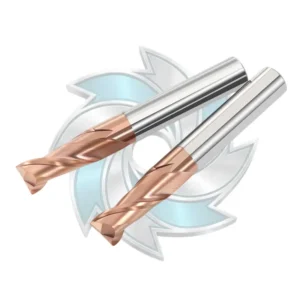
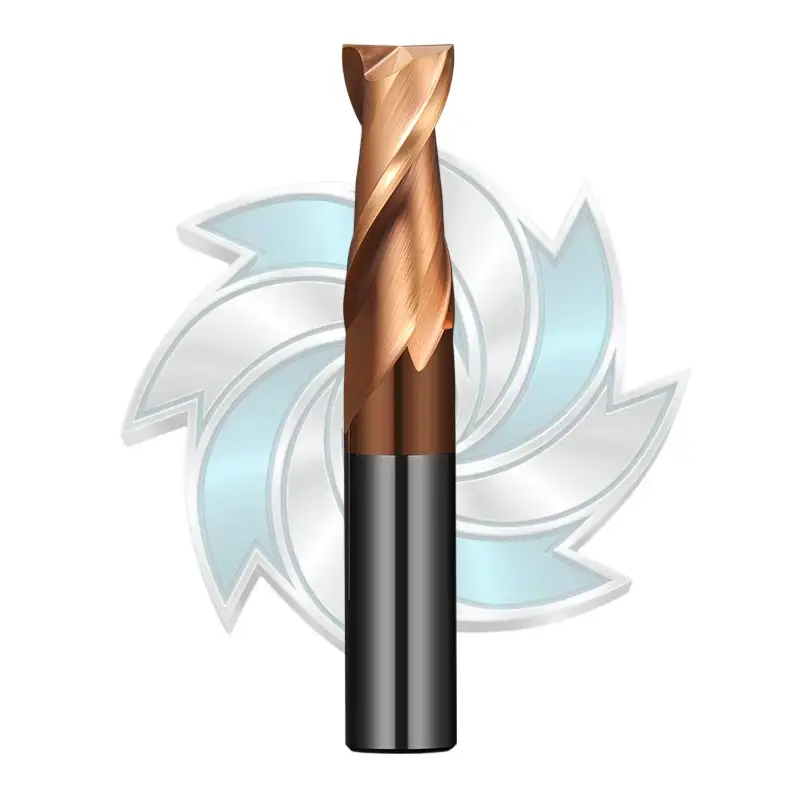
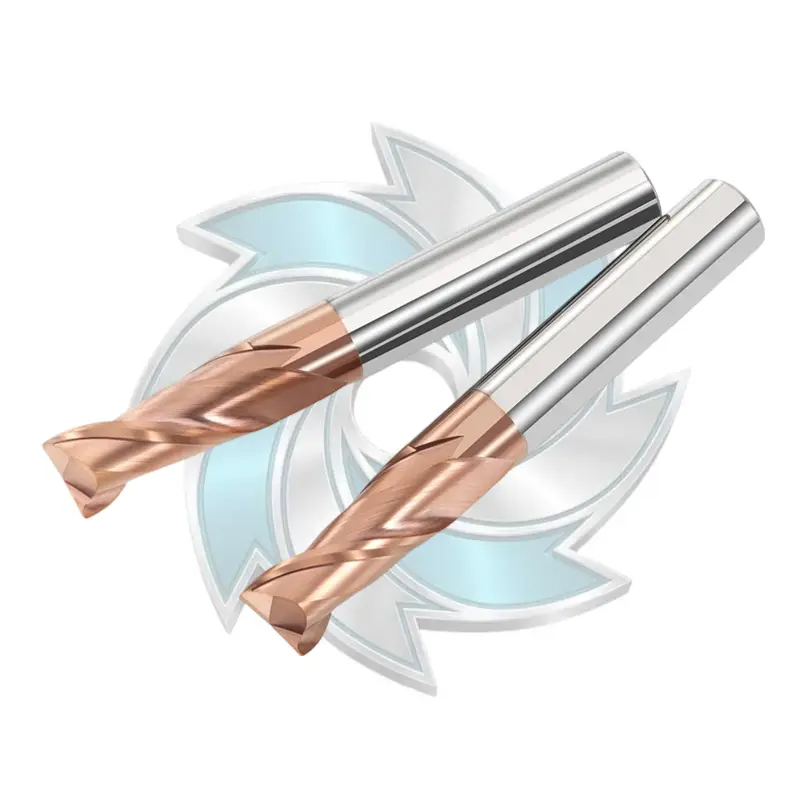
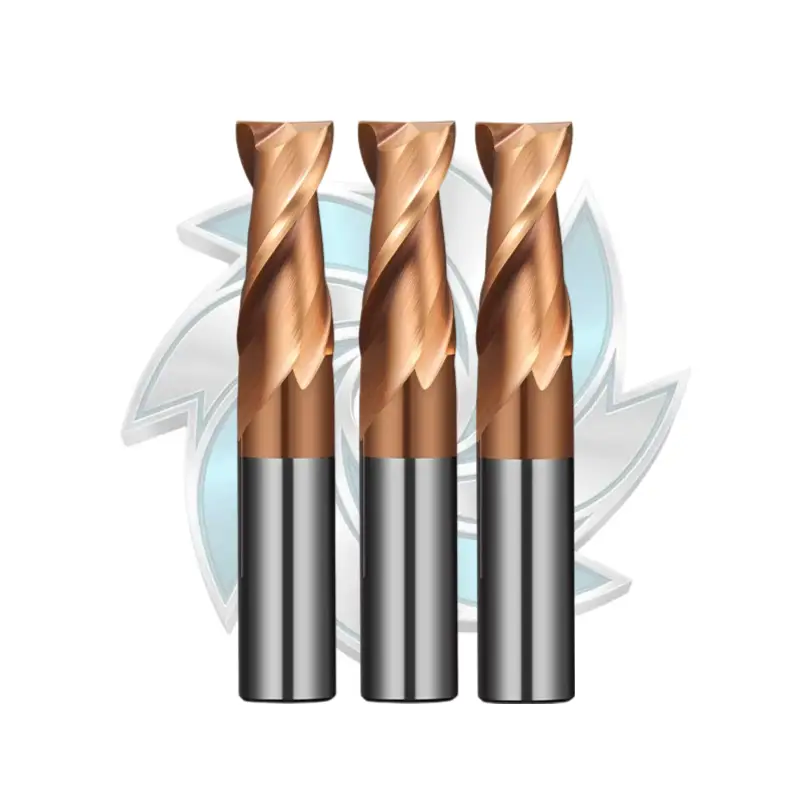
HRC55 Steel 2 Flute Flat End Milling Cutter
Upgrade your CNC machining with our HRC55 2 flute carbide end mill, engineered for precision slotting and milling in carbon and alloy steels. Featuring a reinforced negative rake angle, this 2 flute solid carbide flat end mill ensures maximum wear resistance and long tool life. Contact us for bulk OEM orders.
Frequently Asked Questions (FAQ)
Can I plunge vertically into steel with a 4 flute solid carbide end mill?
Most standard 4-flute tools are “center-cutting,” meaning at least one flute extends across the center point of the tool tip, allowing shallow plunging. However, plunge cutting into steel with a 4 flute solid carbide end mill is tough on the tool because chips have zero escape route under the center web.
Instead of plunging straight down, use a continuous helical ramp (ramping angle between 1.0° and 2.5°) or an orbital entry path. Helical ramping keeps the tool moving across multiple axes, opening up the cut and letting compressed air blow chips safely out of the pocket.
When does a 2-flute cutter still outperform a 4 flute solid carbide end mill?
A 2-flute cutter still outperforms a 4-flute tool when cutting extremely gummy materials like low-carbon 1008 steel, non-ferrous aluminum, brass, or pure copper where chip volume is huge and material tends to weld to the flutes.
Additionally, if your CNC machine has a low-power, low-RPM spindle and cannot achieve the feed rates needed to keep a 4 flute solid carbide end mill cutting cleanly without rubbing, an open 2-flute cutter can help prevent spindle stall and maintain proper chip loads.
Why does my 4 flute solid carbide end mill squeal when profile milling steel walls?
High-pitched squealing during wall profiling indicates regenerative chatter caused by deflection or excessive radial tool engagement. Check your setup:
Shorten tool stickout as much as possible. Remember that deflection increases with the cube of overhang length (L^3).
Reduce your radial depth of cut (ae) and slightly increase your feed per tooth (fz) to force the flute to bite cleanly into the material rather than rubbing.
Verify that your tool holder has minimal runout and adequate gripping torque.
What is the difference between a square flat end mill and a corner radius end mill for steel machining?
A square flat end mill finishes with sharp 90-degree internal corners, which is often a drawing requirement for mold cores, pockets, and stepped shoulders. However, sharp corners are the weakest mechanical point on any carbide cutter.
Adding even a small corner radius (such as 0.5 mm or 1.0 mm) dramatically reinforces that tip, distributing cutting impact forces over a curved profile rather than concentrating stress at a sharp point. If your part prints don’t strictly call for sharp inside corners, a corner-radius tool will almost always deliver longer tool life than a sharp square end mill in steel above 40 HRC.
Upgrade Your Shop’s Steel Machining Efficiency Today
Tool deflection, chatter marks, and broken cutters don’t have to be regular line items on your shop’s scrap report. If your operators are still running slow 2-flute tools on alloy steels or babying old toolpaths because they’re worried about tool failure, it’s time to retool your production process.
Matching the right 4 flute solid carbide end mill to your alloy and hardened steel parts delivers immediate results:
- Double your table feeds without straining spindle horsepower.
- Hold tight tolerances on vertical walls with minimal deflection.
- Produce cleaner surface finishes that reduce or eliminate secondary manual polishing.
- Maximize tool life on tough alloys like 4140, P20, and D2.
Explore the complete lineup of high-performance tooling at Durable Mills. Whether you need high-rigidity cutters like our HRC55 4 Flute Solid Carbide Flat End Mill or specialized deep-pocketing cutters like our HRC55 2 Flute Flat End Mill, our tooling specialists are ready to help optimize your toolpaths and feeds.
Have an upcoming production run in tough or pre-hardened steel? Contact the Durable Mills engineering team today or reach out directly at info@durablemills.com for volume pricing, custom geometries, and practical tooling support built around your machine capabilities.