
Thin aluminum sheets have a habit of fighting back. You dial in what looks like a solid toolpath, the spindle sounds happy for the first few parts, then the edges start curling up, the sheet lifts just enough to chatter, and suddenly every panel needs a hand scrape before it can go to anodizing or assembly. Enclosure and cabinet shops run into this all the time with 1.5 mm to 3 mm 6061 or 5052. The fix is rarely “buy a more expensive machine.” Most of the time it comes down to matching a proper 2 flute carbide end mill for aluminum with the right chip load, support, and direction of cut so you get clean burr-free aluminum cutting with 2-flute end mills instead of secondary work.
We’ve watched this play out on both light gantry routers and heavier verticals. The same geometry rules keep showing up.

Aluminum is soft and sticky. Chips want to weld to the cutting edge the moment heat builds up. On thin sheet the material also has almost no stiffness of its own, so any extra force or recut chip makes the panel flex, lift, or resonate. That flex turns a clean shear into a tear, and the tear becomes a burr. According to basic material behavior described on Aluminium – Wikipedia, the metal’s ductility and tendency to form continuous chips make chip control the central challenge during milling.
Common triggers we see:
A study published in The International Journal of Advanced Manufacturing Technology on formation mechanisms of multi-type burrs on 6061-T6 aluminum alloy examined entry, top, and exit burrs and found feed rate and spindle speed dominate burr size, with up-milling producing roughly 22 % larger burrs than down-milling. That lines up with what shops report when they switch from conventional to climb on thin panels.
Burrs on thin aluminum almost always start as a process problem, not a “we need a deburr station” problem. Get the primary cut right and the hand work disappears.

More flutes give more edges and a stiffer core, which is great on thick plate. On sheet the priority flips. You need open space so the long, stringy chips can leave before they heat up and stick. A 2 flute carbide end mill for aluminum gives the largest gullet volume of any common solid-carbide tool. That extra room is exactly what keeps the edge clean during aluminum sheet routing. The general characteristics of end mills are covered well on the End mill – Wikipedia page, which notes that deep polished flutes, sharp edges, and high rake angles are advantageous when machining aluminum.
Typical geometry that works:
ISO 513:2012 classifies hard cutting materials and places aluminum under the N group for non-ferrous materials. Tools intended for N materials emphasize sharp edges and low adhesion rather than the toughness grades used on steels.
| Tool Feature | Effect on Thin Aluminum Sheet | Practical Result |
|---|---|---|
| 2 flutes | Maximum chip space | Less packing, lower heat, fewer welded chips |
| High helix (35–45°) | Lifts chips upward | Cleaner exit edges, less recutting |
| Polished flutes | Low friction | Reduced built-up edge |
| Sharp positive rake | Lower cutting force | Less sheet deflection and lift |
| Short overall length / reduced stick-out | Higher rigidity | Less chatter on light routers |

Shops that switched from a standard 4-flute or even a general 3-flute to a dedicated 2 flute carbide end mill for aluminum often report the secondary scrape step simply stops. One cabinet fabricator running 2 mm 6061 on a 18 k RPM router cut their hand finishing time by more than half after the change and a modest increase in chip load.
Aluminum likes speed. Most carbide recommendations for 6061 sit in the 800–1500 SFM range. On a router that usually means high RPM and a feed high enough to make a real chip. Milling process basics, including the relationship between surface speed and material removal, are outlined on Milling (machining) – Wikipedia.
Plain-text formulas that shops use every day:
RPM = (SFM × 3.82) / Tool Diameter in inches
Feed rate (IPM) = RPM × Number of Flutes × Chip Load per tooth
Example for a 6 mm (0.236 inch) 2-flute tool targeting 1000 SFM and 0.003 inch per tooth:
RPM = (1000 × 3.82) / 0.236 ≈ 16 186
Feed = 16 186 × 2 × 0.003 ≈ 97 IPM
On thinner sheet you often drop radial engagement and axial depth so the sheet doesn’t oil-can. Starting points that work for many 1.5–3 mm panels:
One enclosure shop running mostly 2 mm panels settled on 0.08 mm per tooth at 18 000 RPM with a 6 mm 2-flute. Burr height dropped enough that they eliminated the manual edge-break step on non-visible surfaces.
Even the right CNC router bits will struggle if the sheet can move. Practical steps that help:

If the sheet is vibrating or lifting, no amount of sharp edge will save the finish. Fix the support first, then address helix direction and milling strategy.
Anonymized example: a panel fabricator making electrical cabinets was seeing 0.3–0.5 mm rolled burrs on 1.6 mm 5052. They moved from a 3-flute general-purpose tool to a polished 2 flute carbide end mill for aluminum, raised chip load, switched fully to climb, and added a 0.2 mm finish pass. Burrs became small enough to knock off with a light nylon brush instead of hand scraping. Cycle time stayed roughly the same because they could run higher feed.
Not every 2-flute is equal. Look for tools ground specifically for non-ferrous work rather than a multi-purpose square end mill that happens to have two flutes. Durable Mills offers both a full Square End Mills range and a dedicated 2-Flute Carbide End Mill for Aluminum that uses the polished high-helix geometry shops prefer for sheet work.
Key selection points:
You can browse the full range of carbide options on the Durable Mills website and see how the aluminum-specific geometry differs from general-purpose tools. Additional technical context on cutting tool classification is available through the official ISO 513 standard page.
| Symptom | Likely Cause | What Usually Fixes It |
|---|---|---|
| Rolled or furry bottom edge | Low chip load or dull edge | Raise feed or drop RPM slightly; replace tool |
| Sheet lifts or chatters | Poor support, up-cut helix pull, or conventional milling rubbing | Improve vacuum/fixture; prefer climb; consider down-cut or compression geometry |
| Chips welded to edge | Packing or wrong coating | Move to 2-flute polished; add air blast |
| Uneven burr along long cuts | Vibration or tool deflection | Shorten stick-out; reduce radial engagement; use better holders |
| Top-side burrs | Exit condition or helix direction | Light finish pass or consider compression geometry |
Most of these disappear once the primary cut is a true shear instead of a rub.


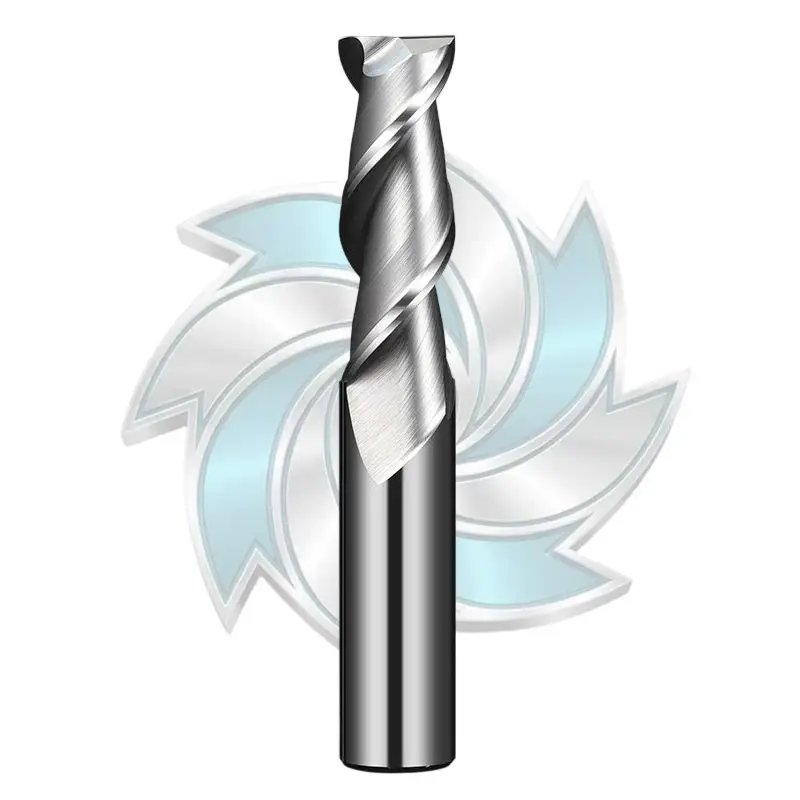
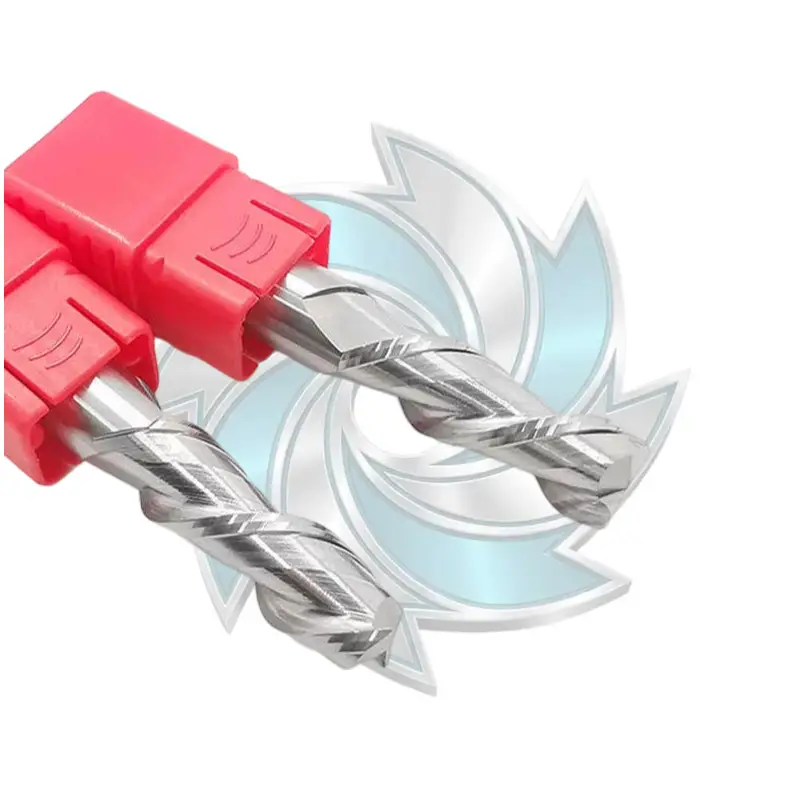
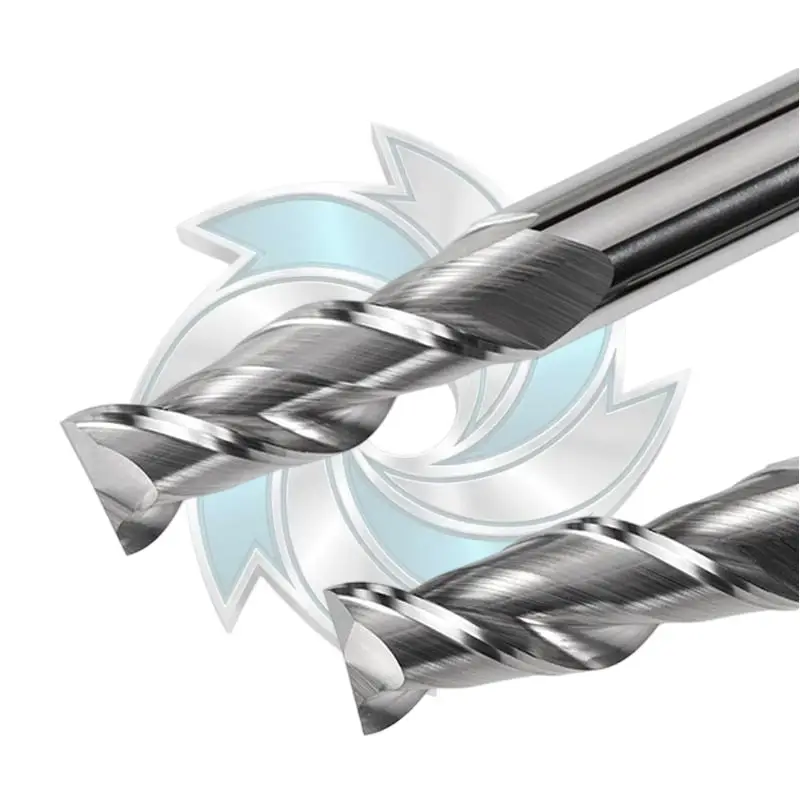
The 2 flute carbide end mill for aluminum is engineered for high-speed CNC milling of aluminum and copper alloys. Featuring a high helix angle and mirror-polished flutes, this carbide end mill for aluminum ensures rapid chip evacuation without edge build-up. As a premium 2 flute aluminum end mill, it delivers superior surface finishing and extended tool life for production milling.
Start around 0.002–0.004 inch per tooth for a 6 mm tool and adjust until the chips are distinct curls rather than dust or long ribbons that wrap. Too light and you rub; too heavy and the sheet flexes.
For pure slotting or thin unsupported sheet, yes—the extra chip space wins. On thicker plate with good support a 3-flute can run higher feeds and still stay clean. Most enclosure work stays in the 2-flute camp.
Many shops do with a strong air blast. A light mist or MQL helps on longer runs or gummier alloys like 5052. Flood coolant is rarely necessary and can make chip management messier on a router.
With a sharp polished 2-flute, proper chip load, and climb milling, most shops see edges that need only a quick brush or none at all for non-cosmetic surfaces. Visible faces may still want a light break, but the heavy hand work goes away.
If your team is still scraping edges on every cabinet or panel run, the combination of the right 2 flute carbide end mill for aluminum and a few process tweaks usually removes that step. Durable Mills builds tools specifically for this kind of aluminum sheet routing work.
Drop a note through the contact page or email info@durablemills.com with your typical sheet thickness, machine type, and current cycle times. We’ll help you pick the diameter and geometry that matches your setup and send pricing. Most shops see the difference on the first job.
Whether you need a single test tool or a full set of CNC router bits and square end mills for ongoing production, the same geometry principles that deliver burr-free aluminum cutting with 2-flute end mills apply. Start with the right flute count and chip evacuation and the rest of the process gets simpler.


